
Kitchen Sink Materials: Types, Pros & Cons, Prices in India (2026 Guide)
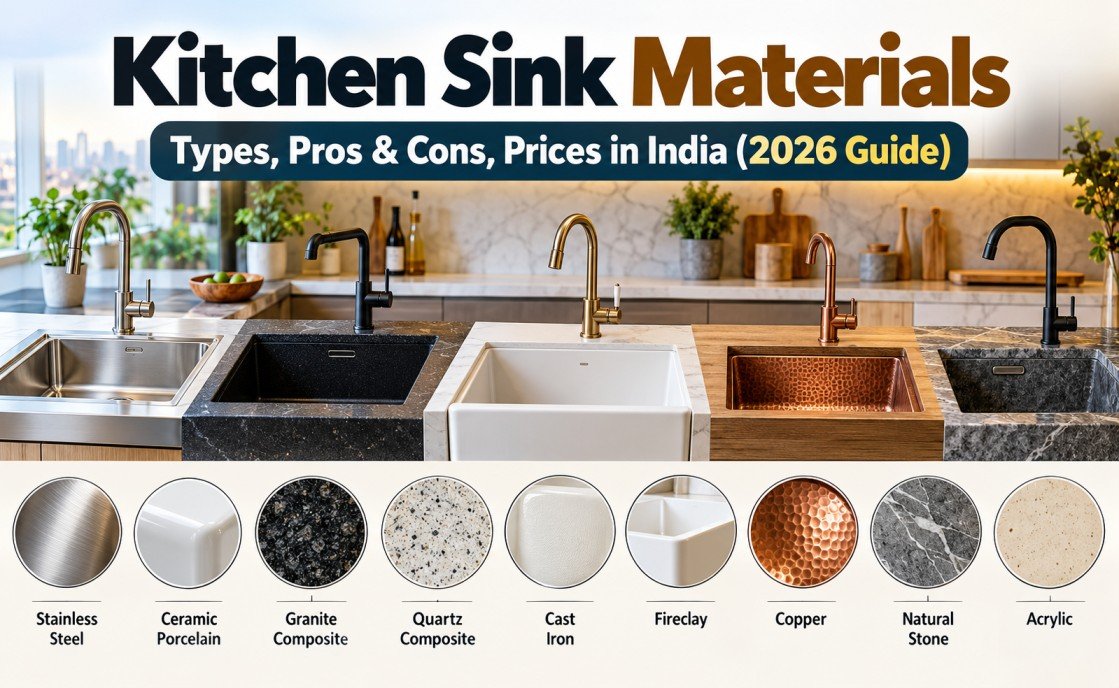
Which kitchen sink material is best?
For most Indian homes, a 304-grade stainless steel sink is the safest choice, and a granite quartz composite sink is the best upgrade if you want a premium look without constant upkeep. The rest (fireclay, ceramic, cast iron, copper, stone, acrylic) suit specific styles or budgets, and each comes with trade-offs you should know before you cut the countertop.
Indian kitchens are tougher on sinks than most. Heavy tadka and oil, turmeric and chai stains, hot pressure cookers and kadhais straight off the flame, and hard water scale all test a material in ways a Western catalogue never mentions. This guide covers 10 kitchen sink materials with honest pros and cons, current price ranges in rupees, and a simple way to choose based on how you actually cook.
Quick picks:
- Best all-rounder and best value: stainless steel (304 grade)
- Best look with low maintenance: granite quartz composite
- Best for a farmhouse or statement kitchen: fireclay
- Best for a tight budget or a rental: stainless steel (thinner gauge) or acrylic
- Best for a showpiece, if you accept the upkeep: copper or natural stone
Kitchen sink materials compared at a glance
Stainless steel is the cheapest way in at roughly ₹3,000, while fireclay and copper sit at the top of the range, reaching ₹40,000 to ₹50,000. In between, composite sinks give the best balance of heat, stain and noise performance.
| Material | Heat resistance | Stain resistance | Noise | Upkeep | Typical price (₹, sink only) | Best for |
| Stainless steel (pressed) | Good | Very good | Moderate | Very low | 3,000 to 15,000 | Every budget, daily Indian cooking |
| Ceramic / porcelain | Good | Good | Low | Low | 3,500 to 12,000 | Guest kitchens, light use |
| Handmade stainless steel | Very good | Very good | Low | Very low | 8,000 to 25,000 | Premium modular kitchens |
| PVD-coated stainless steel | Very good | Very good | Moderate | Low | 8,000 to 20,000 | Black or gold hardware themes |
| Granite composite | Excellent | Excellent | Very low | Low | 8,000 to 25,000 | Heavy cooking, modern kitchens |
| Quartz composite | Excellent | Excellent | Very low | Very low | 10,000 to 30,000 | Quartz countertops, premium builds |
| Enamelled cast iron | Excellent | Very good while enamel is intact | Very low | Medium | 12,000 to 35,000 | Reinforced cabinets, long-term homes |
| Fireclay | Excellent | Excellent | Low | Low | 15,000 to 40,000 | Farmhouse and heritage kitchens |
| Copper (handcrafted) | Good | Moderate | Low | High | 18,000 to 50,000 | Statement kitchens, patina lovers |
Prices are indicative ranges for the sink alone, as of October 2026. Plan for ₹500 to ₹2,000 more for installation, and expect a double bowl to cost 20 to 40 percent more than a single bowl. Natural stone and acrylic sinks are covered below but left out of the table because they are sold made-to-order or at widely varying budget prices.
1. Stainless steel kitchen sinks
Stainless steel is the default for Indian kitchens because it handles hot utensils, heavy scrubbing and daily abuse at the lowest price. The catch is that two sinks that look identical in a showroom can be very different products, and the difference is grade and thickness.
Grade matters more than finish. Look for 304 grade (about 18 percent chromium and 8 percent nickel, sometimes written 18/8). Cheaper 202 grade swaps nickel for manganese, costs less and is more prone to rust and staining, especially with salt, acidic food and hard water. If a listing does not state the grade, assume it is not 304.
Check thickness, not just the label. Sinks are sold by gauge or by millimetres, and a lower gauge number means thicker steel. For daily Indian cooking, 18 gauge is the sensible minimum and 16 gauge is better for heavy use. Thin steel dents under a cast iron tawa and rings loudly when water hits it.
Pressed or handmade. Pressed (drawn) sinks are stamped from one sheet and are the budget option. Handmade sinks are welded and finished by hand, usually from thicker steel, with tighter corners and a sturdier feel, and they cost noticeably more.
Pros
- Withstands hot pans, pressure cookers and abrasive cleaning better than most materials
- Widest range of sizes, bowl layouts and drainboards, so it fits almost any cabinet
- Lowest price of any material, with replacements and accessories easy to find
- Typically lasts 15 to 25 years
Cons
- Can be noisy unless the underside has sound-deadening pads or coating
- Shows scratches over time and water spots in hard-water areas
- Thin or low-grade steel dents, rusts and looks tired within a few years
Price: ₹3,000 to ₹15,000 for pressed sinks, rising to ₹8,000 to ₹25,000 for handmade versions. PVD-coated black, gold or gunmetal finishes cost ₹8,000 to ₹20,000 and are scratch-resistant, but abrasive scrub pads can wear through the coating
2. Granite and quartz composite sinks
Composite sinks are the best match for heavy Indian cooking if you want a quiet, stain-resistant, good-looking sink and can spend more than a steel sink costs. They are made by binding crushed stone, mostly quartz or granite dust at roughly 80 percent or more, with acrylic resin, then moulding the mix into a bowl.
You will see the same product sold as granite sink, quartz sink, granite composite or quartz composite. In practice the construction is the same, and the difference is mainly which mineral dominates and how smooth the surface is. Colour range is wider than steel, with black, grey, beige, white and speckled tones.
Pros
- Very low noise, because the dense body absorbs the sound of water and dishes
- Excellent resistance to scratches, stains and heat, with a non-porous surface that does not hold turmeric or oil easily
- Colour runs through the material, so minor scuffs are less visible than on steel
- Typically lasts 20 to 30 years
Cons
- Costs more than steel, and double bowls with a drainboard cost more again
- Bleach and harsh acidic cleaners can degrade the resin binder over time, so use pH-neutral cleaners
- Heavier than steel, so check cabinet strength before you buy
- Dark colours show hard-water scale, so wipe dry after washing if your water is hard
- Small chips can usually be filled with a colour-matched repair kit, but deep cracks mean replacing the sink
Price: ₹8,000 to ₹25,000 for granite composite and ₹10,000 to ₹30,000 for quartz composite. Undermount composite sinks, which sit beneath the countertop for a seamless edge, run ₹12,000 to ₹35,000 and need a stone or composite counter to support them (source).
3. Ceramic, fireclay and enamelled cast iron sinks
These three give the glossy white, farmhouse look, but they behave very differently in an Indian kitchen. Fireclay is the durable choice, ceramic is the budget choice that chips more easily, and cast iron is the heavyweight that needs a strong cabinet.
Ceramic and porcelain
Ceramic sinks are vitrified clay with a glaze. They look clean and cost less than fireclay, but the material is less dense, so a dropped kadhai or pressure cooker can chip the glaze, and white surfaces can show turmeric staining once the glaze is damaged. They suit guest kitchens, utility areas and light-use homes better than a busy main kitchen.
- Pros: low price, bright glossy finish, easy to wipe clean while the glaze is intact
- Cons: chips under heavy cookware, shorter life of roughly 10 to 20 years, can stain once chipped
- Price: ₹3,500 to ₹12,000
Fireclay
Fireclay sinks are moulded from clay and fired at very high temperature with a fused glaze, which makes them denser and harder than ordinary ceramic. They are the classic apron-front farmhouse sink and suit traditional or heritage-style kitchens.
- Pros: excellent heat and stain resistance, non-porous glossy surface, typically 20 to 30 years of life
- Cons: the highest price among mainstream materials, heavy, and a very hard knock from cast iron cookware can still chip the glaze
- Price: ₹15,000 to ₹40,000
Enamelled cast iron
A cast iron sink is a solid iron body coated in thick porcelain enamel. It absorbs noise and impact better than almost anything else and can last 25 to 40 years, but it is very heavy and the enamel is its weak point: once it chips, the iron underneath can rust.
- Pros: extremely durable body, near-silent, glossy finish
- Cons: needs reinforced cabinetry, enamel must be protected from chips, moderate upkeep
- Price: ₹12,000 to ₹35,000
Before ordering any of the three, confirm that your base cabinet and countertop can carry the weight. Heavy sinks are a common source of sagging cabinets and sequencing problems during installation
4. Copper, natural stone, acrylic and solid surface sinks
These four are niche choices. Copper and stone are for showpiece kitchens where looks come first, while acrylic is a low-cost option for light use. Few Indian homes need them, so read the trade-offs before you commit.
Copper
Handcrafted copper sinks are naturally antimicrobial and develop a darker patina with age, so no two look alike. They suit eclectic or artisanal kitchens, but they react with acidic foods, need regular cleaning and waxing, and change colour over time, which some owners love and others do not.
- Pros: antimicrobial surface, distinctive handmade look, roughly 20 to 30 years of life
- Cons: high upkeep, moderate stain resistance, the most expensive mainstream material
- Price: ₹18,000 to ₹50,000
Natural stone (marble, soapstone, granite)
A sink carved from solid stone is heat-resistant, strong and visually striking, and it pairs naturally with a matching countertop. It is also heavy, usually made to order, needs periodic sealing to resist stains, and sits at the top of the cost scale, so get a written quote and confirm cabinet support first.
Acrylic
Acrylic sinks are light, cheap and easy to install, which makes them popular for DIY jobs, rentals and secondary sinks. The trade-off is durability: they scratch, dent and stain more easily than the materials above, and hot cookware placed straight in the bowl can damage them. They are not suited to heavy daily Indian cooking.
Solid surface
Solid surface sinks are moulded from an acrylic and mineral blend that can be shaped into a seamless unit with the countertop, so there is no rim to trap grime. They look excellent and can be sanded to remove light scratches, but they are less heat-tolerant than composite sinks, so use a trivet for hot pans.
How to choose the right sink material for your kitchen
Start with how you cook and what your water is like, then match budget and style. The table below turns that into a quick decision.
| Your situation | Best pick | Why | Think twice about |
| Heavy daily cooking with oil, masala and hot kadhais | Granite or quartz composite, or 304 stainless steel at 16 to 18 gauge | Both take heat and scrubbing, and composite stays quiet and resists turmeric | Ceramic, acrylic |
| Hard water and visible scale | 304 stainless steel with a satin finish | Brushed steel hides water spots better than a glossy surface | Dark composite colours, polished steel |
| Tight budget under ₹6,000 | Pressed 304 stainless steel at 18 gauge | Best durability per rupee | 202 grade, thin steel |
| Rental or short-term home | Pressed stainless steel | Cheap, easy to replace or take with you | Fireclay, cast iron, copper |
| Long-term forever home | Composite, fireclay or handmade stainless | Lasts 20 to 30 years with little fuss | Acrylic, thin steel |
| Farmhouse or traditional look | Fireclay | Authentic apron-front style and strong glaze | Ceramic if the kitchen is busy |
| Black or dark modern kitchen | Black composite or PVD-coated steel | Matches black taps and dark counters | Abrasive scrub pads on PVD |
| Quartz or stone countertop | Undermount composite | Seamless edge and the easiest wipe-down | Undermount on laminate or wood |
| Small kitchen or limited cabinet strength | Stainless steel | Light weight and compact bowl sizes | Cast iron, stone, fireclay |
Two more checks before you buy. First, match the sink to the cabinet: measure the base unit and confirm the cutout size before ordering. Second, decide on bowl layout based on your habits. A single large bowl handles big pots and tawas, while a double bowl lets you soak and rinse at the same time.
How to care for each sink material
Most sink damage comes from the wrong cleaner or a rough habit, not from the material itself. Wipe the sink dry after use in every case, because standing water leaves scale in hard-water areas.
| Material | Clean with | Avoid |
| Stainless steel | Mild soap, a soft cloth, and a vinegar-water wipe for scale | Steel wool, bleach left on the surface, leaving wet utensils to sit |
| PVD-coated steel | Soft cloth and mild soap | Abrasive pads, which can cut through the coating |
| Granite and quartz composite | pH-neutral cleaner, warm water, soft sponge | Bleach, ammonia, acidic cleaners, dropping heavy pots |
| Ceramic and fireclay | Non-abrasive cream cleaner and a soft sponge | Abrasive powders, striking the glaze with cast iron |
| Enamelled cast iron | Mild soap and a soft cloth | Chipping the enamel, gritty scrubbers |
| Copper | Mild soap, dry immediately, wax periodically | Acidic foods left sitting, harsh chemicals |
| Natural stone | Stone-safe cleaner, periodic sealing | Acids such as lemon and tamarind left on the surface |
Common mistakes that shorten a sink’s life
- Buying on looks and ignoring grade, thickness or composition
- Skipping sound-deadening pads on a stainless steel sink
- Putting a red-hot pan straight into any sink, even a heat-resistant one, because sudden temperature change stresses the material
- Using the same harsh cleaner on every sink type
- Not checking cabinet strength before fitting a heavy sink
Frequently asked questions
What is the best kitchen sink material in India?
For most homes it is 304-grade stainless steel at 16 to 18 gauge, because it balances price, durability and easy care. If you want a quieter, more stain-resistant sink and can spend ₹8,000 or more, granite or quartz composite is the best upgrade.
Which is better, a stainless steel or a granite (quartz) sink?
Stainless steel wins on price, range of sizes and heat tolerance. Composite wins on noise, stain resistance and looks. Choose steel if budget or flexibility matters most, and composite if you want a premium, low-noise sink.
What is the difference between 304 and 202 stainless steel sinks?
304 has more nickel and chromium, resists rust and staining better, and costs more. 202 uses less nickel, is cheaper, and is more likely to rust or stain, particularly with salt, acids and hard water.
Which sink material is the most durable?
Enamelled cast iron and fireclay have the longest typical lifespans, at roughly 25 to 40 and 20 to 30 years respectively. Composite and good stainless steel are close behind and far easier to install and maintain.
Which is the cheapest kitchen sink material?
Pressed stainless steel starts around ₹3,000, with ceramic close behind at about ₹3,500. Acrylic is also inexpensive but wears out faster under heavy use.
Do granite and quartz composite sinks stain with turmeric?
The surface is non-porous, so turmeric and oil rarely stain it if you rinse promptly. Avoid bleach and strong acids, which can damage the resin and dull the finish.
Does a stainless steel sink rust?
A good 304 sink resists rust well, but no stainless steel is completely rust-proof. Rust spots usually come from low-grade steel, iron particles left on the surface, or standing water and salt, so keep the sink clean and dry.
How much does a kitchen sink cost in India?
Prices run from about ₹3,000 for a basic steel sink to ₹40,000 or more for fireclay, with copper reaching ₹50,000. Add ₹500 to ₹2,000 for installation.
Conclusion
Pick the material that matches how you cook, your water and your cabinet, not just the showroom look. Choose 304 stainless steel for value, composite for a quiet premium sink, fireclay for a farmhouse statement, and save copper and stone for kitchens where looks outweigh upkeep. Whatever you pick, check grade or composition, thickness, and the base unit’s strength before you order.